
Puppy Development Stages: The Complete Growth Guide for New and Experienced Owners
If you’ve ever looked at your puppy and wondered “why is she suddenly acting like a completely different dog,” you’re not imagining things. Puppies move through distinct, predictable developmental stages — and understanding them is honestly the single best thing you can do to raise a confident, well-adjusted adult dog. Miss a window (like proper socialization between 3-14 weeks), and you’ll be playing catch-up for years. Nail it, and you’ll set your pup up for a lifetime of good behavior.
This guide breaks down every puppy development stage in detail, explains what’s happening physically and mentally at each phase, and — because a Chihuahua and a Cane Corso are basically raised on two different planets — covers how breed size and group affect the timeline.
Why Understanding Puppy Development Stages Matters
Puppies aren’t just “small dogs.” Their brains and bodies go through rapid, sequential changes, and each stage has its own developmental tasks. Push too hard, too early (or too late), and you can create fear issues, poor bite inhibition, or missed learning opportunities that are tough to reverse in adulthood.
Knowing the stages helps you:
- Time socialization and training for maximum impact
- Recognize normal (if occasionally maddening) behavior vs. red flags
- Adjust nutrition, exercise, and expectations to your puppy’s actual developmental age
- Avoid over-exercising growing joints or under-stimulating a developing brain
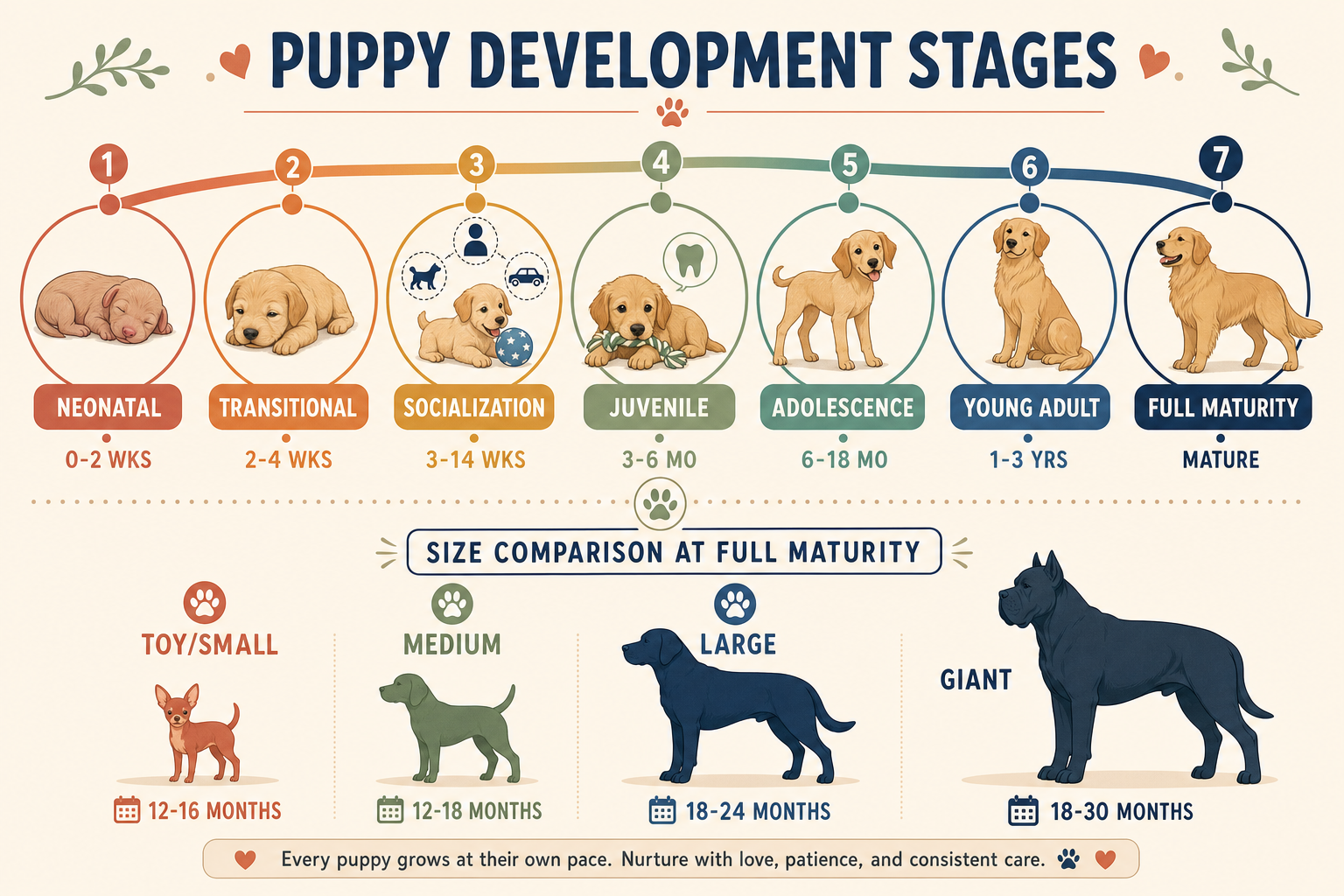
The 7 Core Puppy Development Stages
1. Neonatal Stage (Birth to 2 Weeks)
This is the “potato” phase — puppies are blind, deaf, and almost entirely dependent on mom. They can’t regulate their own body temperature and spend nearly all their time eating and sleeping.
- Senses: Eyes and ear canals are sealed shut
- Mobility: Can only crawl using front legs; no standing
- Key milestone: Eyes begin opening around day 10-14
- What owners should do: Almost nothing except keep the whelping area warm, quiet, and clean. This is all mom’s job.
2. Transitional Stage (2 to 4 Weeks)
Things get exciting fast. Eyes and ears open, baby teeth erupt, and puppies start wobbling around on their feet.
- Eyesight and hearing come online (though still blurry/muffled)
- First teeth appear around 2-3 weeks
- Tails start wagging, and play behavior (biting littermates, tumbling) begins
- Puppies start moving away from the nest to eliminate — early sign of den instinct
3. Socialization Period (3 to 12-14 Weeks) — The Most Important Window
This is the golden window that breeders and trainers obsess over, and for good reason: research consistently shows this is when a puppy’s brain is most receptive to forming positive associations with new people, animals, sounds, surfaces, and experiences.
Sub-phase: 3-7 weeks (with littermates)
- Puppies learn bite inhibition from mom and siblings (a yelp from a littermate teaches “that was too hard”)
- Play fighting teaches social boundaries and body language
- This is why reputable breeders never place puppies before 8 weeks
Sub-phase: 8-12/14 weeks (with new family)
- Puppy typically goes home around 8 weeks
- Prime time for controlled exposure to: new people, other vaccinated dogs, car rides, household sounds (vacuum, doorbell), different surfaces (grass, tile, gravel), gentle handling of paws/ears/mouth
- A secondary “fear period” often appears around 8-11 weeks — a normally confident pup may suddenly spook at something ordinary. Don’t force it; let them approach on their own terms.
Owner action items for this stage:
- Aim for 100+ positive new experiences before 14 weeks (the “Rule of 100” many trainers recommend)
- Start basic house manners and crate training
- Begin puppy socialization classes once your vet clears it (usually after first round of shots)
- Avoid punishment-based corrections — this age group is extremely sensitive to fear conditioning
4. Juvenile/Ranking Period (3 to 6 Months)
Baby teeth fall out, adult teeth come in, and puppies start testing boundaries — figuring out where they fit in the family “pack.”
- Increased independence and testing of rules (“selective hearing” phase)
- Teething and increased chewing (protect your shoes)
- Growth plates are still open — avoid high-impact exercise, forced long runs, or jumping from heights
- Ideal time to reinforce obedience basics: sit, stay, recall, loose-leash walking
5. Adolescence (6 to 18 Months, Breed-Dependent)
Buckle up. This is the stage most owners describe as “I swear my dog forgot everything I taught him.” Adolescence brings a surge of hormones (especially if not yet spayed/neutered), a second fear period (often 6-14 months), and a testing of every rule you thought was solid.
- Second fear/flight period can appear — same rule as before: no forcing, no punishing fear
- Sexual maturity begins (varies widely by size/breed — more below)
- Energy levels often peak; structured exercise and mental enrichment are critical
- Regression in training is common and NORMAL — consistency, not more corrections, is the fix
6. Young Adulthood (1 to 3 Years, Breed-Dependent)
Physical growth slows or stops, but mental/emotional maturity is often still catching up. Many breeds aren’t considered fully “adult” in temperament until 2-3 years old.
- Energy starts to stabilize (though large working breeds may stay intense longer)
- This is when most dogs “settle” into their permanent personality
- Continued training and socialization still pay dividends here
7. Full Maturity (Varies by Breed)
The finish line — full physical and behavioral maturity, though the timing varies dramatically by size (details below).
Puppy Development Timeline at a Glance
| Stage | Age Range | Key Developments |
|---|---|---|
| Neonatal | 0-2 weeks | Blind, deaf, fully dependent on mom |
| Transitional | 2-4 weeks | Eyes/ears open, first teeth, first steps |
| Socialization | 3-14 weeks | Bite inhibition, critical social learning window |
| Juvenile | 3-6 months | Adult teeth, boundary testing, house training solidifies |
| Adolescence | 6-18 months | Hormones, second fear period, training regression |
| Young Adult | 1-3 years | Personality settles, energy stabilizes |
| Full Maturity | 1-3+ years (breed-dependent) | Complete physical/behavioral maturity |
How Breed Size Changes Everything: Small vs. Medium vs. Large vs. Giant Breeds
Here’s the part most generic puppy guides skip — and it’s a big deal if you’re comparing something like a Chihuahua to a Cane Corso. The bigger the breed, the longer and slower the developmental timeline. A small dog reaches physical and often behavioral maturity while a giant breed is still very much a “toddler.”
Toy & Small Breeds (Chihuahuas, Dachshunds, French Bulldogs)
- Reach adult size fastest, often by 8-12 months
- Sexual maturity can start as early as 4-6 months
- Growth plates close relatively early, so moderate exercise is safer sooner
- Adolescent “testing” phase tends to be shorter, but small-dog owners often under-socialize because “she’s so tiny, she doesn’t need training” — this is a mistake. Small breeds like Chihuahuas need just as much structured socialization to avoid fear-based reactivity and “small dog syndrome.”
- French Bulldogs (a brachycephalic breed) mature quickly size-wise but need extra care around exercise intensity and heat due to their airway structure at any age
Medium Breeds (some Dachshund lines fall here too, depending on type)
- Physical maturity around 12-15 months
- Behavioral adolescence typically wraps by 18-24 months
- Generally a good balance of energy and manageability during the teenage phase
Large Breeds (German Shepherds, Rottweilers)
- Physical growth continues to 18-24 months
- Growth plates in large breeds don’t fully close until roughly 12-18 months — this is critical: avoid high-impact activity (jumping, long forced runs, stairs) too early to protect hips and elbows, especially in German Shepherds who are already predisposed to hip dysplasia
- Behavioral/emotional maturity often not complete until 2-3 years
- Both German Shepherds and Rottweilers are working breeds bred for jobs — under-stimulation during adolescence often shows up as destructive behavior or excess barking. Mental enrichment matters as much as physical exercise here.
Giant Breeds & Massive Working Breeds (Cane Corsos)
- Slowest timeline of all: physical growth can continue to 18-24+ months, with some large mastiff-type dogs not fully “filling out” until 3 years
- Growth plates may not close until 18 months or later — jumping and rough play should be limited well past the age owners expect
- Cane Corsos in particular carry an especially long socialization runway because of their size and guardian instincts — early, consistent, positive exposure to strangers and other dogs during the 8-14 week window (and reinforced through adolescence) is non-negotiable for producing a stable, non-reactive adult
- Behavioral maturity often lags physical size by a year or more — a 100+ lb Cane Corso at 10 months may still have the impulse control of a much younger, smaller puppy
Quick Comparison Chart
| Breed Group | Example Breeds | Physical Maturity | Growth Plate Closure | Behavioral Maturity |
|---|---|---|---|---|
| Toy/Small | Chihuahua | 8-12 months | ~8-10 months | 12-18 months |
| Small-Medium | Dachshund, French Bulldog | 10-14 months | ~10-12 months | 12-18 months |
| Large | German Shepherd, Rottweiler | 18-24 months | 12-18 months | 2-3 years |
| Giant | Cane Corso | 18-24+ months | 18+ months | 2-3 years |
Practical Guidelines by Stage: What to Actually Do
- 0-8 weeks: Trust the breeder/mom process; don’t rush weaning or separation
- 8-14 weeks: Prioritize socialization above almost everything else — this window closes and doesn’t reopen
- 3-6 months: Start structured obedience training; manage teething; watch exercise intensity for larger breeds
- 6-18 months: Expect regression, stay consistent, don’t panic during the second fear period, keep exercise breed-appropriate
- 1-3 years: Continue reinforcing training as personality settles; adjust food and exercise to adult maintenance levels once growth plates close (check with your vet for your specific breed)
Common Mistakes Owners Make Across All Stages
- Skipping socialization because a puppy hasn’t finished vaccines (talk to your vet — many recommend controlled, low-risk socialization can start before the final round)
- Over-exercising large and giant breed puppies before growth plates close, leading to joint issues later
- Assuming small breeds don’t need training or socialization
- Punishing fear responses during either fear period, which can create lasting phobias
- Expecting adult-level impulse control before the brain (and for large/giant breeds, the body) is actually done developing
Final Thoughts
What has been your experience with the different puppy development stages? If you comment below, you can share your experience & expertise with everyone. Also, if you would like one of our breed handbooks which provide insights into how to care for Chihuahuas, Dachshunds, German Shepherds, Rottweilers, Cane Corsos or French Bulldogs, just let us know below.
Every puppy — whether it’s a 5-pound Chihuahua or a 100-pound Cane Corso — moves through the same broad developmental map, but the pace and stakes shift dramatically with size and breed purpose. Understanding these puppy development stages isn’t just trivia; it’s the roadmap that tells you when to socialize hardest, when to ease up on exercise, and when to expect (and forgive) a little chaos. Match your training, exercise, and expectations to your puppy’s actual developmental stage, not just their age in months, and you’ll end up with a far more balanced, confident adult dog.